BUILDING AN INNOVATION WORKFORCE
From an Award-winning Entrepreneurship Program to New Degrees Aimed at Meeting Workforce Needs, UH is Helping the City Polish Its High-tech Image


Let’s be honest. When Amazon summarily dismissed Houston last year, leaving the city off its short list for a second national headquarters, it stung. But it also served to jumpstart the city’s fervent desire to build a new innovation culture, one suited to the 21st century’s global knowledge economy.
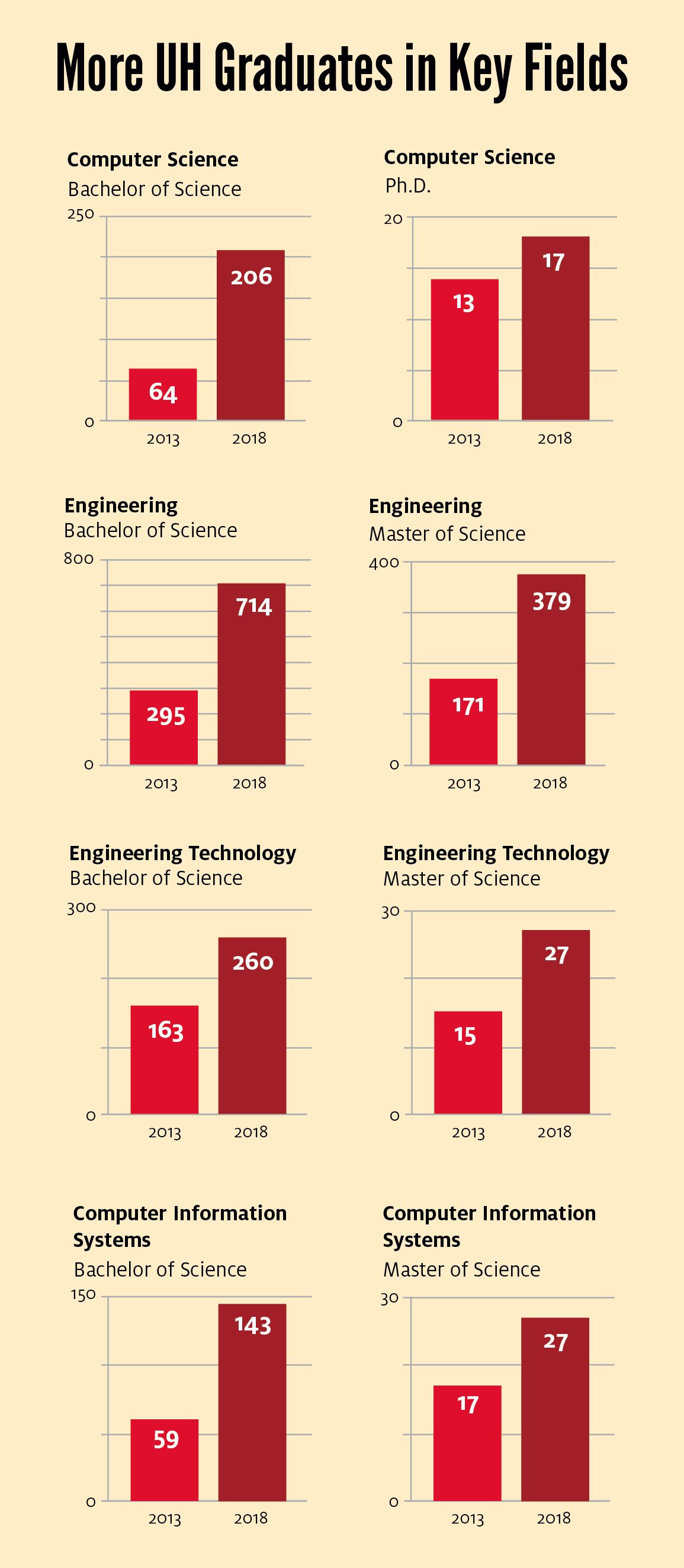
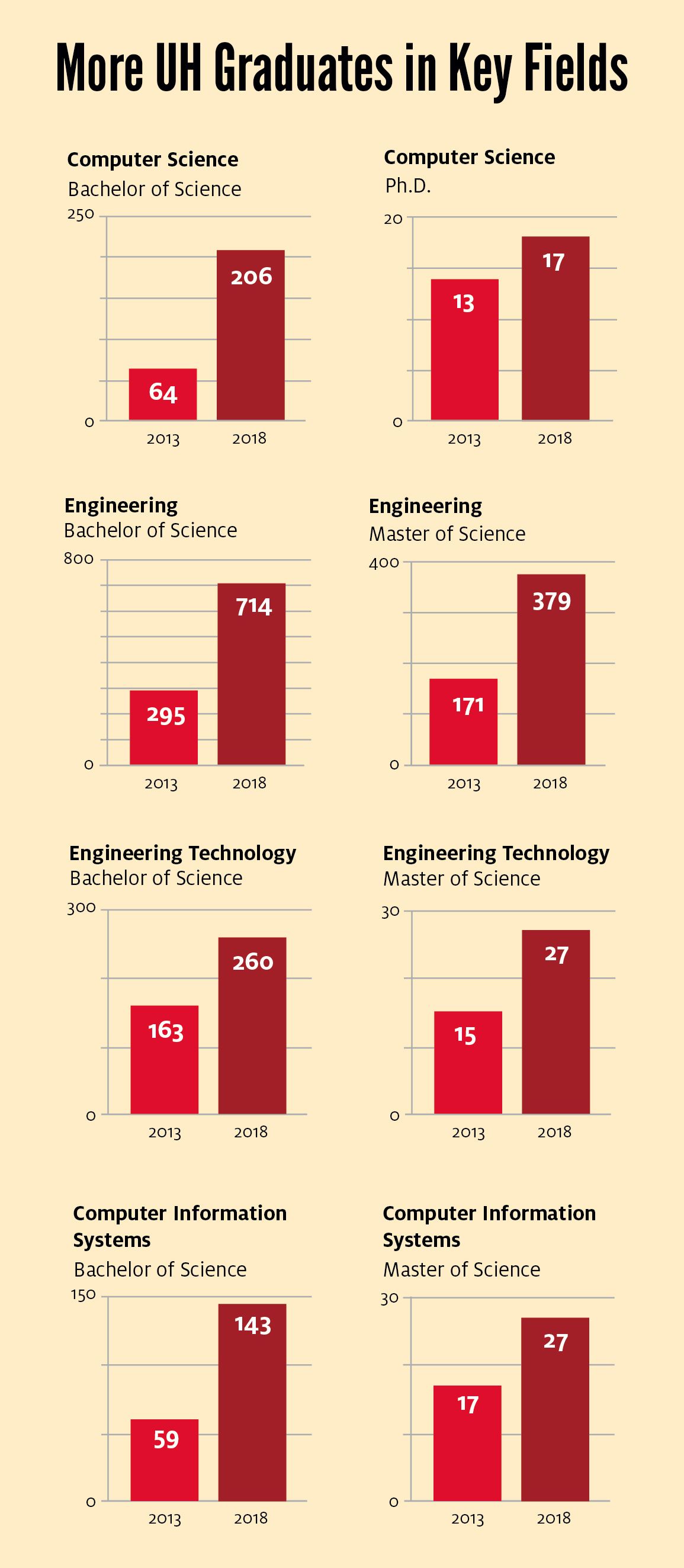
The University of Houston is committed to doing its part, continuing its work to boost the number of graduates in engineering, computer science and other tech fields (see graphic) and launching new academic short-term and degree programs designed to help the city succeed. Notably, a partnership with Hewlett Packard Enterprise has spurred the HPE Data Science Institute’s engagement with industry.
The re-branded UH Technology Bridge venue offers both facilities and commercialization services to help faculty inventors and those from outside the University turn ideas into businesses. And the $2 million Chancellor’s Technology Bridging Fund announced this summer will take that further, offering grants to faculty from across the UH System to help bridge the gap between research and commercialization.
Academia, clearly, has a vital role to play in preparing the economy for the future.
“Houston’s rapidly accelerating innovation ecosystem is built around collaboration across the entire ecosystem,” said Bob Harvey, president and CEO of the Greater Houston Partnership. “Academic institutions are a critical component of that work, along with corporations, startups and investors.”
Universities have been key incubators of innovation in key tech markets across the country, he said, ranging from Silicon Valley to Washington, D.C. “As we continue to elevate Houston’s innovation ecosystem, our top universities will continue serving as a critical part of our effort,” Harvey added. “The University of Houston’s partnership with Hewlett Packard Enterprise to accelerate the development of the HPE Data Science Institute is a perfect example of the collaboration needed to elevate Houston as a digital tech hub.”
Other new programs add to the efforts.
New Education Programs
The Stephen Stagner Sales Excellence Institute in the C.T. Bauer College of Business is launching the Sales Academy this fall, a non- credit certificate program open to people with a four-year degree, designed to teach the specialized skills needed to sell technology.
The institute’s executive director, Randy Webb, said talks with leaders at Houston Exponential, an organization dedicated to spurring innovation, suggested tech sales skills have been a missing piece as the city tries to accelerate its startup scene.
“It’s an eight-week course designed to give people the basics to sell technology. It’s a way to, in a very short time, prepare people to do inside sales for tech companies,” Webb said. “We can train them. This can give them a leg up.”
The College of Technology has taken a different tack with a new degree program in Technology Leadership and Innovation Management, as well as two minors that focus on innovation. David Crawley, professor of practice in the College, said the idea came from talks with industry, as companies look for people that can bring new approaches and aptitude to bear on today’s problems.
Crawley said the programs will give students the tools and skills to solve problems and create unique opportunities. “We believe anybody can be taught to be innovative. It’s not just for the gifted few.”
John Jeffers, director of geosciences at Southwestern Energy, said learning a new way of thinking amplifies the value of technical and business skills. “Whether innovating within an organization as an ‘intrapreneur,’ or stepping out to create something new, people who are familiar with the mindset and practice of innovation have an enormous advantage.”

Let’s be honest. When Amazon summarily dismissed Houston last year, leaving the city off its short list for a second national headquarters, it stung. But it also served to jumpstart the city’s fervent desire to build a new innovation culture, one suited to the 21st century’s global knowledge economy.
The University of Houston is committed to doing its part, continuing its work to boost the number of graduates in engineering, computer science and other tech fields (see graphic) and launching new academic short-term and degree programs designed to help the city succeed. Notably, a partnership with Hewlett Packard Enterprise has spurred the HPE Data Science Institute’s engagement with industry.
The re-branded UH Technology Bridge venue offers both facilities and commercialization services to help faculty inventors and those from outside the University turn ideas into businesses. And the $2 million Chancellor’s Technology Bridging Fund announced this summer will take that further, offering grants to faculty from across the UH System to help bridge the gap between research and commercialization.
Academia, clearly, has a vital role to play in preparing the economy for the future.
“Houston’s rapidly accelerating innovation ecosystem is built around collaboration across the entire ecosystem,” said Bob Harvey, president and CEO of the Greater Houston Partnership. “Academic institutions are a critical component of that work, along with corporations, startups and investors.”
Universities have been key incubators of innovation in key tech markets across the country, he said, ranging from Silicon Valley to Washington, D.C. “As we continue to elevate Houston’s innovation ecosystem, our top universities will continue serving as a critical part of our effort,” Harvey added. “The University of Houston’s partnership with Hewlett Packard Enterprise to accelerate the development of the HPE Data Science Institute is a perfect example of the collaboration needed to elevate Houston as a digital tech hub.”
Other new programs add to the efforts.

New Education Programs
The Stephen Stagner Sales Excellence Institute in the C.T. Bauer College of Business is launching the Sales Academy this fall, a non- credit certificate program open to people with a four-year degree, designed to teach the specialized skills needed to sell technology.
The institute’s executive director, Randy Webb, said talks with leaders at Houston Exponential, an organization dedicated to spurring innovation, suggested tech sales skills have been a missing piece as the city tries to accelerate its startup scene.
“It’s an eight-week course designed to give people the basics to sell technology. It’s a way to, in a very short time, prepare people to do inside sales for tech companies,” Webb said. “We can train them. This can give them a leg up.”
The College of Technology has taken a different tack with a new degree program in Technology Leadership and Innovation Management, as well as two minors that focus on innovation. David Crawley, professor of practice in the College, said the idea came from talks with industry, as companies look for people that can bring new approaches and aptitude to bear on today’s problems.
Crawley said the programs will give students the tools and skills to solve problems and create unique opportunities. “We believe anybody can be taught to be innovative. It’s not just for the gifted few.”
John Jeffers, director of geosciences at Southwestern Energy, said learning a new way of thinking amplifies the value of technical and business skills. “Whether innovating within an organization as an ‘intrapreneur,’ or stepping out to create something new, people who are familiar with the mindset and practice of innovation have an enormous advantage.”
“We believe anybody can be taught to be innovative. It’s not just for the gifted few.”
Top-Ranked Entrepreneurship Program
Houston is, of course, an entrepreneurial city, and Bauer’s Wolff Center for Entrepreneurship is a shining example of that. The undergraduate program has been ranked No. 1 or No. 2 in the country by the Princeton Review for eight of the past 11 years. But faculty say what really sets it apart is the sheer volume of students who participate in its programs: about 2,500 UH students take at least one entrepreneurship course every year, and more than 700 complete the multicourse certificate program.
Students who have taken entrepreneurship classes at UH within the past decade have started 1,006 businesses, with identified funding of just over $238 million, said Ed Blair, chairman of the Department of Marketing and Entrepreneurship.
Dave Cook, who directs the Wolff Center, says that’s a perfect example of why these programs matter.
“Entrepreneurship is crucial to Houston’s future for the simple reason that roughly 70% of new jobs are created by entrepreneurial companies,” he said. “Established companies account for a large portion of existing jobs, but new jobs come from new and growing companies. For Houston to continue to grow, and for people to have jobs, entrepreneurship is a must.”